Database Schema Design: Prisma vs Drizzle ORM Comparison
A practical comparison of Prisma and Drizzle ORMs for TypeScript projects, covering schema design, query building, migrations, and performance trade-offs.
Introduction
Choosing an ORM for your TypeScript project is one of those decisions that reverberates through every database interaction in your application. Two tools have emerged as frontrunners in the modern TypeScript ecosystem: Prisma and Drizzle. Both promise type-safe database access, but they approach the problem from fundamentally different philosophies.
Prisma positions itself as a “next-generation ORM” with its own schema language, powerful code generation, and an emphasis on developer experience. Drizzle takes the opposite approach: a TypeScript-native ORM that keeps you as close to SQL as possible while still providing full type safety. The question isn’t which is “better” - it’s which philosophy aligns with your project’s needs.
In this comparison, we’ll build the same data model in both ORMs, explore their query patterns, examine their type inference capabilities, and discuss when to reach for each tool. By the end, you’ll have the practical knowledge to make an informed choice for your next project.
Schema definition: Two philosophies
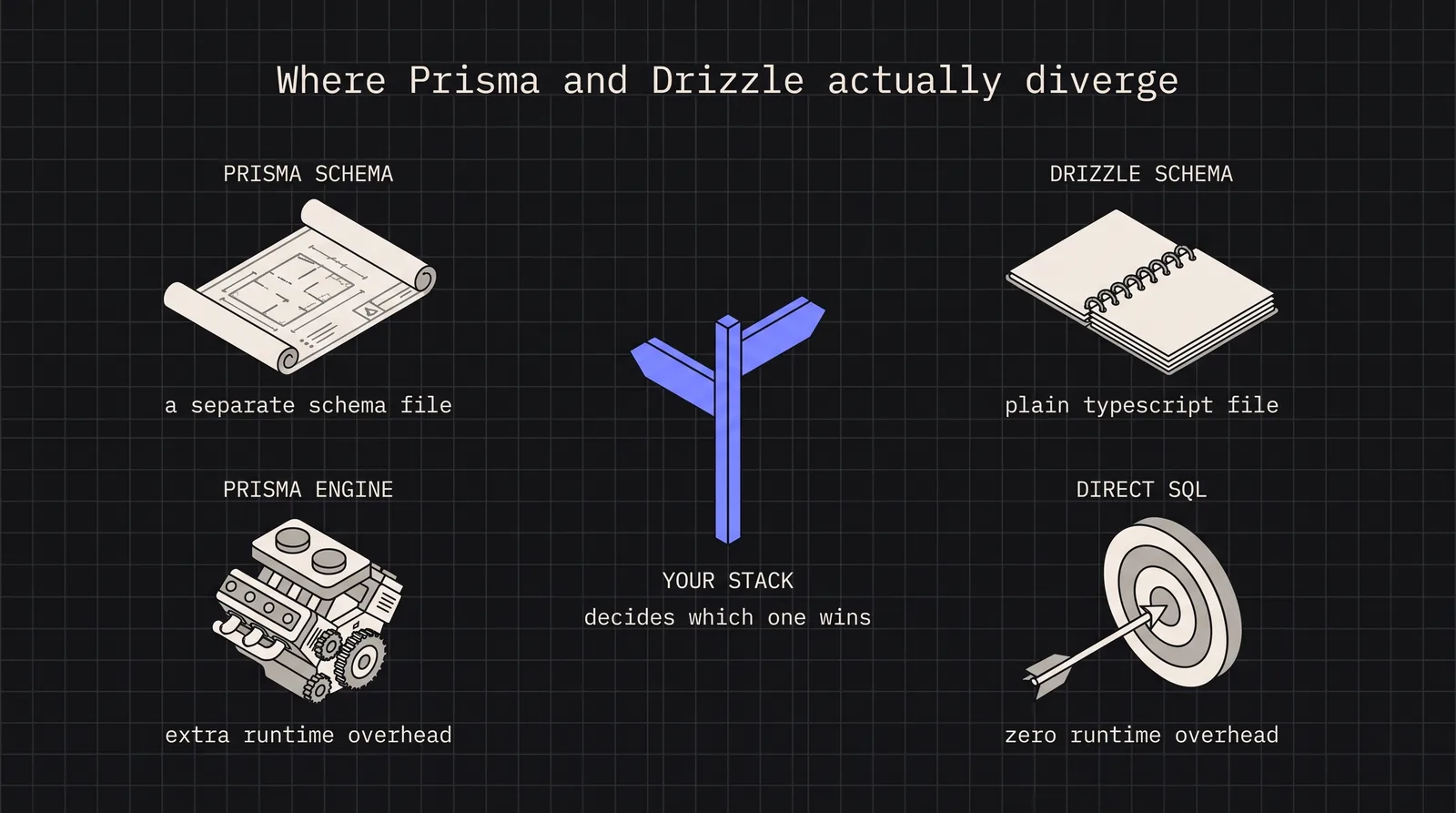
The most visible difference between Prisma and Drizzle is how you define your database schema. This choice affects everything from your mental model to your deployment pipeline.
Prisma: Domain-specific language
Prisma uses its own schema definition language (SDL), stored in a schema.prisma file. This approach prioritizes readability and abstracts away database-specific syntax.
prisma/schema.prisma
generatorclient {
provider = "prisma-client-js"
}
datasourcedb {
provider = "postgresql"
url = env("DATABASE_URL")
}
modelUser {
id Int@id@default(autoincrement())
email String@unique
name String?
role Role @default(USER)
posts Post[]
profile Profile?
createdAt DateTime@default(now())
updatedAt DateTime@updatedAt
}
modelPost {
id Int@id@default(autoincrement())
title String
content String?
published Boolean@default(false)
author User @relation(fields: [authorId], references: [id])
authorId Int
tags Tag[]
createdAt DateTime@default(now())
}
modelProfile {
id Int@id@default(autoincrement())
bio String
user User @relation(fields: [userId], references: [id])
userId Int@unique
}
modelTag {
id Int@id@default(autoincrement())
name String@unique
posts Post[]
}
enumRole {
USER
ADMIN
MODERATOR
}
After defining your schema, you generate the client:
Generating Prisma Client
npxprismagenerate
This produces a fully-typed client with all your models, relations, and enums available as TypeScript types.
Drizzle: TypeScript-native schemas
Drizzle defines schemas directly in TypeScript, using its schema builder functions. This keeps everything in one language and gives you the full power of TypeScript’s type system.
Pro Tip: Drizzle requires explicit junction table definitions for many-to-many relationships, while Prisma handles them implicitly. This gives you more control but requires more code.
Query building: Abstraction vs SQL proximity
The query APIs reveal the core philosophical difference between these ORMs. Prisma abstracts SQL into method chains, while Drizzle mirrors SQL structure.
The key difference: Prisma requires a code generation step after schema changes, while Drizzle types update instantly because they’re derived from TypeScript code.
Drizzle’s configuration lives in a drizzle.config.ts file:
drizzle.config.ts
import { defineConfig } from'drizzle-kit';
exportdefaultdefineConfig({
schema: './src/db/schema.ts',
out: './drizzle/migrations',
dialect: 'postgresql',
dbCredentials: {
url: process.env.DATABASE_URL!,
},
});
Feature
Prisma
Drizzle
Migration format
SQL files with metadata
Pure SQL files
Schema introspection
prisma db pull
drizzle-kit introspect
Visual studio
Prisma Studio (web)
Drizzle Studio (web)
Shadow database
Required for migrate dev
Not required
Custom migrations
Manual SQL editing
Manual SQL editing
Warning: Both ORMs allow direct database pushes for development, but always use proper migrations in production to maintain a clear history and enable rollbacks.
Performance considerations
Performance differences between ORMs often come down to the queries they generate and their runtime overhead.
Query efficiency
Prisma’s approach:
Uses a Rust-based query engine binary
Batches related queries to reduce roundtrips
N+1 protection through automatic batching
Additional memory overhead from the engine process
Drizzle’s approach:
Zero runtime overhead (compiles to direct SQL)
No separate query engine process
Prepared statements for repeated queries
You control query complexity directly
Benchmark comparison
Based on typical workload benchmarks (your mileage may vary):
Operation
Prisma
Drizzle
Notes
Simple select
~1.2ms
~0.8ms
Drizzle faster (no engine overhead)
Complex join
~3.5ms
~2.8ms
Similar, depends on query
Bulk insert (1000 rows)
~450ms
~380ms
Drizzle slightly faster
Cold start
~800ms
~50ms
Prisma engine initialization
Memory usage
+40-60MB
Minimal
Prisma query engine
Note: These benchmarks are illustrative. Real-world performance depends heavily on your specific queries, database configuration, and infrastructure.
When performance matters
Choose Drizzle when:
Serverless/edge environments where cold starts matter
Memory-constrained environments
You need maximum control over generated SQL
High-throughput applications with simple queries
Choose Prisma when:
Developer productivity outweighs raw performance
You benefit from automatic query optimization
Your team prefers abstraction over SQL knowledge
You need advanced features like Prisma Accelerate
Making the choice
After examining both ORMs, here’s a decision framework based on project characteristics:
Choose Prisma when:
Team composition: Mixed experience levels, stronger in TypeScript than SQL
publishedPosts: count(sql`CASE WHEN ${posts.published} THEN 1 END`),
avgLength: avg(sql`LENGTH(${posts.content})`),
})
.from(posts)
.groupBy(posts.authorId)
.having(gt(count(posts.id), 5));
Conclusion
Prisma and Drizzle represent two valid approaches to the same problem: type-safe database access in TypeScript. Prisma optimizes for developer experience with its abstracted schema language and powerful client generation. Drizzle optimizes for control and performance with its SQL-first, TypeScript-native approach.
Key takeaways:
Schema design: Prisma uses a DSL, Drizzle uses TypeScript - both provide full type safety
Query patterns: Prisma abstracts SQL, Drizzle embraces it - choose based on team preferences
Type inference: Prisma requires generation, Drizzle infers from code - impacts development workflow
Migrations: Both provide robust tooling with slightly different workflows
Performance: Drizzle has lower overhead, Prisma has better automatic optimization
Neither ORM is universally “better.” The right choice depends on your team’s SQL proficiency, your performance requirements, and your development workflow preferences. Both are excellent tools actively maintained by their communities.