Exercise Selection Algorithms with Equipment Constraints
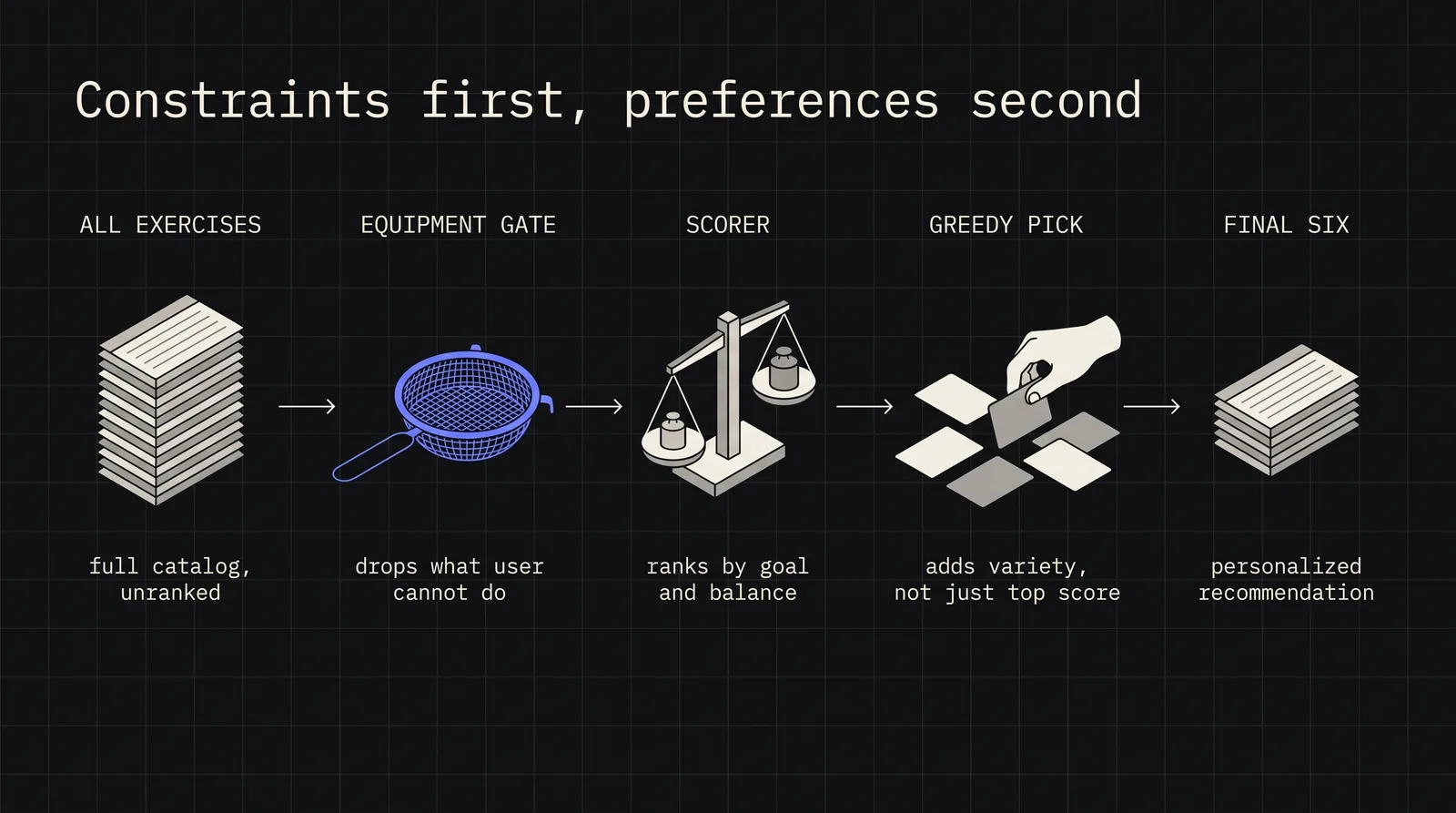
Build intelligent exercise selection systems that respect equipment availability, balance muscle group coverage, and personalize recommendations based on user goals and history.
Introduction
Building a fitness application that recommends exercises sounds straightforward until you encounter the complexity of real-world constraints. A user wants to build upper body strength, but they’re working out at home with only dumbbells and a pull-up bar. Another user has access to a full gym but is recovering from a knee injury. How do you recommend exercises that are both effective and actually possible for each user?
This is a constraint satisfaction problem at its core - we need to find exercises that simultaneously satisfy multiple requirements: available equipment, targeted muscle groups, user fitness level, and personal preferences. Unlike simple filtering, effective exercise selection requires balancing competing objectives and learning from user feedback over time.
In this article, we’ll build an intelligent exercise selection system that handles equipment constraints, balances muscle group coverage, and personalizes recommendations using machine learning. The techniques apply broadly to any recommendation system with hard constraints and soft preferences.
Modeling the exercise domain
Before building algorithms, we need a solid data model. A well-designed schema captures the relationships between exercises, equipment, and muscle groups.
rating INTEGERCHECK (rating BETWEEN1AND5) -- user satisfaction
);
This schema captures the essential relationships: exercises require equipment, target muscle groups with varying intensity, and users have both equipment access and workout history.
Pro Tip: The is_required flag in exercise_equipment allows modeling alternatives - a chest press can be done with a barbell OR dumbbells, not necessarily both.
Equipment constraint filtering
The first layer of our selection algorithm handles hard constraints. If a user doesn’t have a barbell, they simply cannot do barbell squats - no amount of scoring can change that.
Building the equipment filter
equipment_filter.py
from dataclasses import dataclass
from typing import Set, List
import psycopg2
from psycopg2.extras import RealDictCursor
@dataclass
classExercise:
id: int
name: str
difficulty_level: int
movement_pattern: str
is_compound: bool
required_equipment: Set[int]
optional_equipment: Set[int]
primary_muscles: Set[int]
secondary_muscles: Set[int]
classExerciseRepository:
def__init__(self, db_connection):
self.conn = db_connection
defget_all_exercises(self) -> List[Exercise]:
"""Load exercises with their equipment and muscle requirements."""
with self.conn.cursor(cursor_factory=RealDictCursor) as cur:
Filter exercises to only those possible with available equipment.
An exercise is possible if ALL required equipment is available.
Optional equipment may enhance the exercise but isn't necessary.
"""
valid_exercises = []
for exercise in exercises:
# Check if all required equipment is available
if exercise.required_equipment.issubset(available_equipment):
valid_exercises.append(exercise)
return valid_exercises
This filter performs a simple but crucial check: an exercise passes only if every piece of required equipment is available. The issubset operation handles this elegantly.
Handling equipment alternatives
Real fitness applications need smarter equipment handling. A user might be able to substitute a barbell bench press with dumbbells or even a push-up.
After filtering for equipment, we need to ensure workout balance. A good workout plan shouldn’t have five chest exercises and nothing for the back - that creates imbalances and increases injury risk.
Coverage scoring algorithm
muscle_balance.py
from collections import defaultdict
from typing import List, Dict, Tuple
import numpy as np
@dataclass
classMuscleGroupTarget:
muscle_id: int
name: str
target_sets: int# weekly target
current_sets: int = 0
classMuscleBalancer:
"""Ensures balanced muscle group coverage in exercise selection."""
# Recommended weekly sets by muscle group for hypertrophy
The coverage score uses a key insight: filling gaps is more valuable than adding to already-covered muscles. A workout with 15 chest sets and 0 back sets desperately needs a back exercise, even if another chest exercise would score higher on other metrics.
Relevance scoring and ranking
With feasible exercises identified and balance considered, we need to rank exercises by relevance to the user’s goals. This is where machine learning enhances traditional filtering.
The gradient boosting model learns which exercise attributes correlate with user satisfaction. Feature importance reveals insights - for example, you might discover that compound movements strongly predict satisfaction for strength-focused users.
Note: With sufficient data, this approach can capture nuanced preferences that hand-tuned rules miss. Start with the rule-based scorer and add ML when you have at least a few thousand user ratings.
if balance_score > 0.1 or len(selected) < 3: # always take first few
selected.append(exercise)
return selected
Conclusion
Building an intelligent exercise selection system requires treating constraints and preferences as separate concerns. Equipment availability creates hard boundaries that must be respected. Muscle balance and user goals create soft preferences that guide ranking within those boundaries.
Key takeaways:
Model the domain carefully - The database schema enables all downstream algorithms
Filter before scoring - Hard constraints (equipment) narrow the candidate pool efficiently
Balance competing objectives - Muscle coverage, user goals, and variety all matter
Learn from feedback - ML personalization improves recommendations over time
Keep it interpretable - Combine rule-based scoring with ML rather than replacing it entirely
The same architectural patterns apply to other constrained recommendation problems: recipe selection with dietary restrictions, travel planning with budget limits, or course scheduling with prerequisite chains. The key is separating hard constraints from soft preferences and building systems that respect both.